A
ENGINE → ELECTRICITYREEV × PHEV / FOLLOW THE ENERGY
PHEV vs REEV -
Which is the
superior technology?
The same electric and series capabilities. Plus direct engine drive and engine–motor torque together.
The comparison: pure-series REEV vs series-parallel PHEV. Designs vary by model.
LIVE POWER FLOW01 / PHEV
Electric powerEngine driveMotor torque
SCROLL TO SEE WHAT CHANGES↓AN EXPLAINER FOR PAKISTAN
Plug inBOTH
Electric driveBOTH
Engine-to-wheel driveSERIES-PARALLEL PHEV
01 / THE POWER LAB
REEV vs PHEV:
Electricity usage and Fuel usage
Same scenario. Two architectures.
Tap a mode and watch the energy move.
B
SAME SERIES ABILITYPHEV SERIES-PARALLEL
Simplified schematics. Flow is qualitative, not a power or fuel-use measurement. Inverters and some gearing are omitted.
The series animation shows a battery-buffered example. Generator electricity can also feed the motor directly through the shared electrical system; all power does not have to be stored in the battery first.
02 / SAME ABILITIES. EXTRA POWER PATHS.
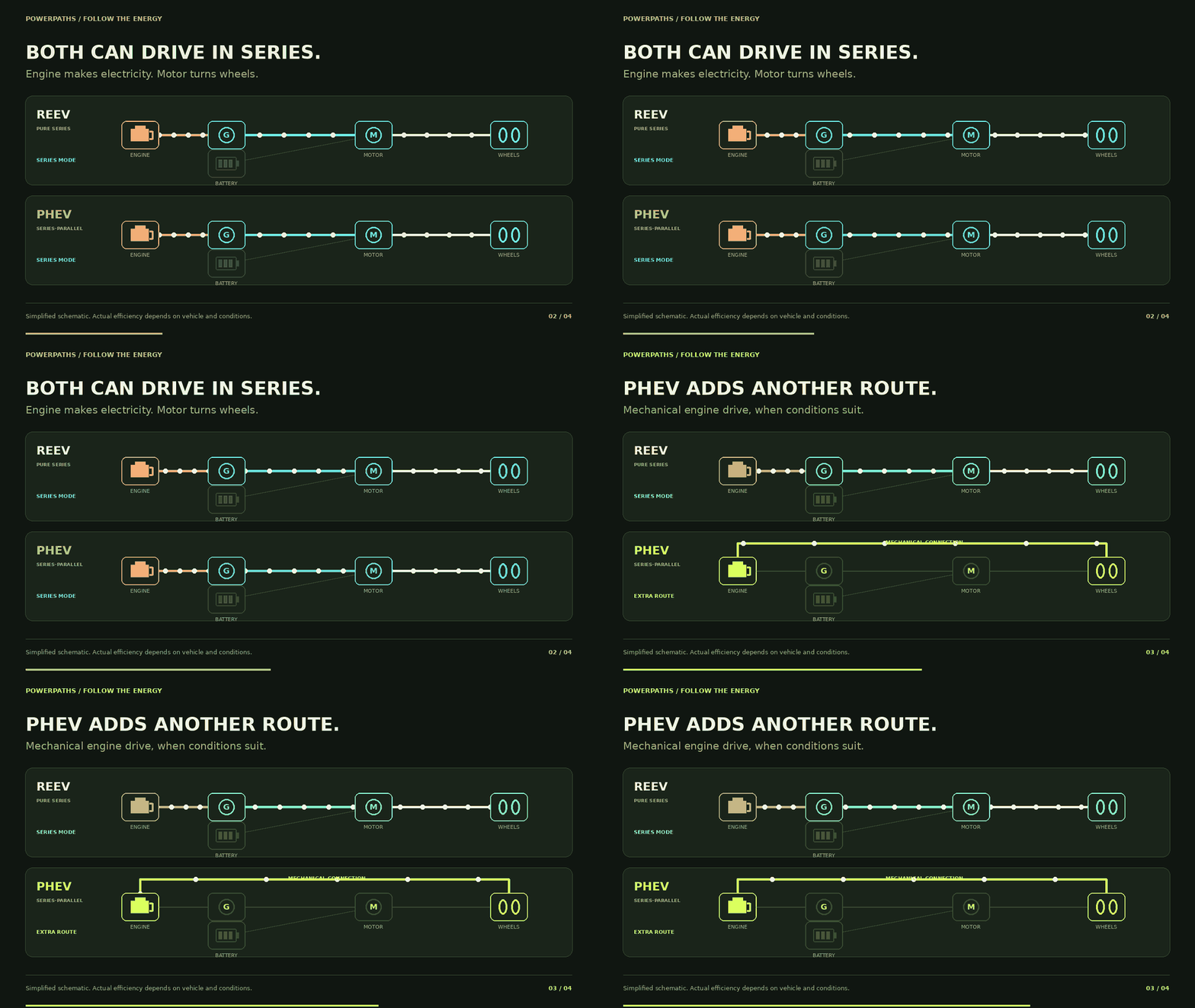
PHEV has all the capabilities of REEV.
Then goes beyond it with Together / Parallel mode to give you more power and torque.
REEV + PHEV / SHARED CAPABILITIES
A PHEV can do what a REEV does.
Both can drive on battery power. Both can use the engine to make electricity.
Electric
Battery
Motor
Wheels
Series
Engine
Generator
Battery
Motor
Wheels
Series diagram: a battery-buffered example. The generator can also supply the motor directly through the electrical system.
PHEV / EXTRA CAPABILITIES
Advantages of PHEV technology
01 / PHEV ADVANTAGE
ONLY IN THE PHEV ARCHITECTURE SHOWNDirect drive
Engine
Mechanical link, when beneficial
Wheels
Only in series-parallel PHEV. The engine can drive the wheels through a mechanical link. This direct-drive capability is not available in a pure-series REEV.
02 / PHEV ADVANTAGE
ONLY IN THE PHEV ARCHITECTURE SHOWNTogether / Parallel mode
EngineMechanical torque
CouplingMechanical link
WheelsCombined wheel torque
BatteryElectric power
MotorMotor torque
Only in series-parallel PHEV. The engine and electric motor can drive the wheels together. This Together / Parallel capability is not available in a pure-series REEV.
Try Together mode ↗03 / WHAT THE EXTRA ABILITY TAKES
Why do companies choose
PHEV over REEV?
More development work buys more power-flow choices for the customer. The mechanical link is the key addition.
✳
✳
ILLUSTRATIVE COUPLING / SYNCHRONISE → CONNECT01
More hardware to developDesign, integrate and validate the mechanical link, gearing and packaging.
02
More control softwareCoordinate engine torque, motor torque, battery power and mode selection.
03
More calibration and testingTune clutch transitions, heat, noise and driveability across more operating states.
Adding and coordinating the mechanical path creates extra development tasks and associated R&D cost. This is an engineering inference from the added hardware and controls; comparable manufacturer R&D budgets and development times are not publicly established here.
WHAT THE EXTRA DEVELOPMENT DELIVERS
Combined torque
Engine and motor can drive together for extra assistance when accelerating or climbing.
Direct engine drive
A mechanical route to the wheels, with the option to avoid generator-to-motor conversion when beneficial.
More operating choices
Electric, series HEV and parallel HEV operation let the controller choose a suitable power path.
THE ARCHITECTURE CONCLUSION
Series-parallel PHEV is the more versatile, more advanced power-flow architecture.
It retains electric and series operation, then adds mechanical engine drive and parallel HEV operation. More engineering creates more ways to deliver power and manage energy. Actual fuel economy, performance and value still depend on the vehicle.
04 / SEE THE WHOLE IDEA
The same journey,
two different paths.
A 60-second visual recap.
No technical background needed.
About the low-battery road animation
This is a conditional power-balance illustration, not a vehicle performance test. If sustained road demand exceeds generation and the usable battery reserve is exhausted, available power can be limited. Low charge alone does not mean every REEV must stop. Both architectures can recharge on the move when spare power and battery limits allow. A PHEV also remains subject to fuel, battery, thermal and control limits.
05 / THE PAKISTAN QUESTION
The same duty.
For PHEV and REEV.
Both use an engine. Both can burn fuel. Both plug in. These shared fundamentals support equal duty and tax treatment for comparable vehicles.
DRAFT PROPOSAL / 16 OCT 2026
Proposed GST for eligible vehicles in the supplied Auto Policy Draft 3: section 4.4.1, page 22; Appendix V, Table F, page 43. Qualification conditions apply.
Draft figures, not enacted tax advice. This chart compares GST only, not customs duty or total tax.CAMPAIGN PROPOSAL / EQUAL SALES TAX
9% sales tax. For both.
Both use a fuel-burning engine, electric drive and a plug-in battery. We propose the same 9% sales-tax rate for comparable REEVs and PHEVs.
Campaign recommendation, not an enacted rate. Customs-duty parity is also proposed separately.Why this is a proposal rather than a live tax calculator
The 16 October 2026 document is marked Draft 3 Updated. Its proposed 6% and 9% GST rates are shown for both locally assembled vehicles and imported CBUs. Current liability depends on enacted law, notifications, classification and vehicle eligibility. A customs classification alone does not establish a vehicle’s complete tax burden or its environmental performance.
THE SERIES-PARALLEL ADVANTAGE
The shared abilities.
Plus more ways to drive.
Series HEV is shared. A series-parallel PHEV adds parallel mode—Together mode—and a direct mechanical engine path.
See the difference again↗